
DOWNLOAD YOUR FREE COPY OF NENDO's 2021 TREND REPORT
Take our COVID-19 Vaccine Misinformation quiz and find out how good you are at spotting misinformation

DOWNLOAD YOUR FREE COPY OF NENDO's 2021 TREND REPORT
Walk into almost any corporate boardroom in Nairobi today and you will hear the exact same question: "How do we use AI?"
It is the wrong question. And it is quietly costing African brands far more than they realise.
The core reality? AI will not fix a disorganised company. It will only expose it. It shines a relentless light on the true quality of your systems, your data, your workflows, and your team's taste. All of it. At speed.
This stark truth took centre stage at a recent panel hosted by Aga Khan University's Graduate School of Media & Communications (GSMC). Moderated by Shahin Viehweber, the conversation featured two heavyweights operating at the absolute frontier of African digital strategy: Mark Kaigwa, CEO of Nendo, and Nyandia Gachago, Founder of MintyLime.
What made the room lean in was the dynamic balance between their two vantage points. Mark anchored the conversation in systems, data, and operational discipline, while Nyandia expanded it toward creativity, strategy, and the messy human realities of running live campaigns. Between them, a single argument emerged.
The generic narrative that "AI is changing communications" is no longer useful. The sharper reality is that African brands do not have an AI problem first. They have an organisation, data, workflow, and judgment problem. AI only becomes powerful when it is layered onto clear processes, clean context, human taste, and local intelligence.
So why the rush to automate before we have cleaned up our own houses?
Often, it comes down to hidden incentives. It is the Upton Sinclair principle in practice: it is difficult to get a person to understand something when their salary, status, or comfort depends on not understanding it. The undocumented process is someone's job security. The messy spreadsheet is someone's quiet leverage. AI threatens both.
To move past this, brands need to stop reaching for tools and start building a disciplined African AI operating model. We call it the C.H.A.I. Framework:
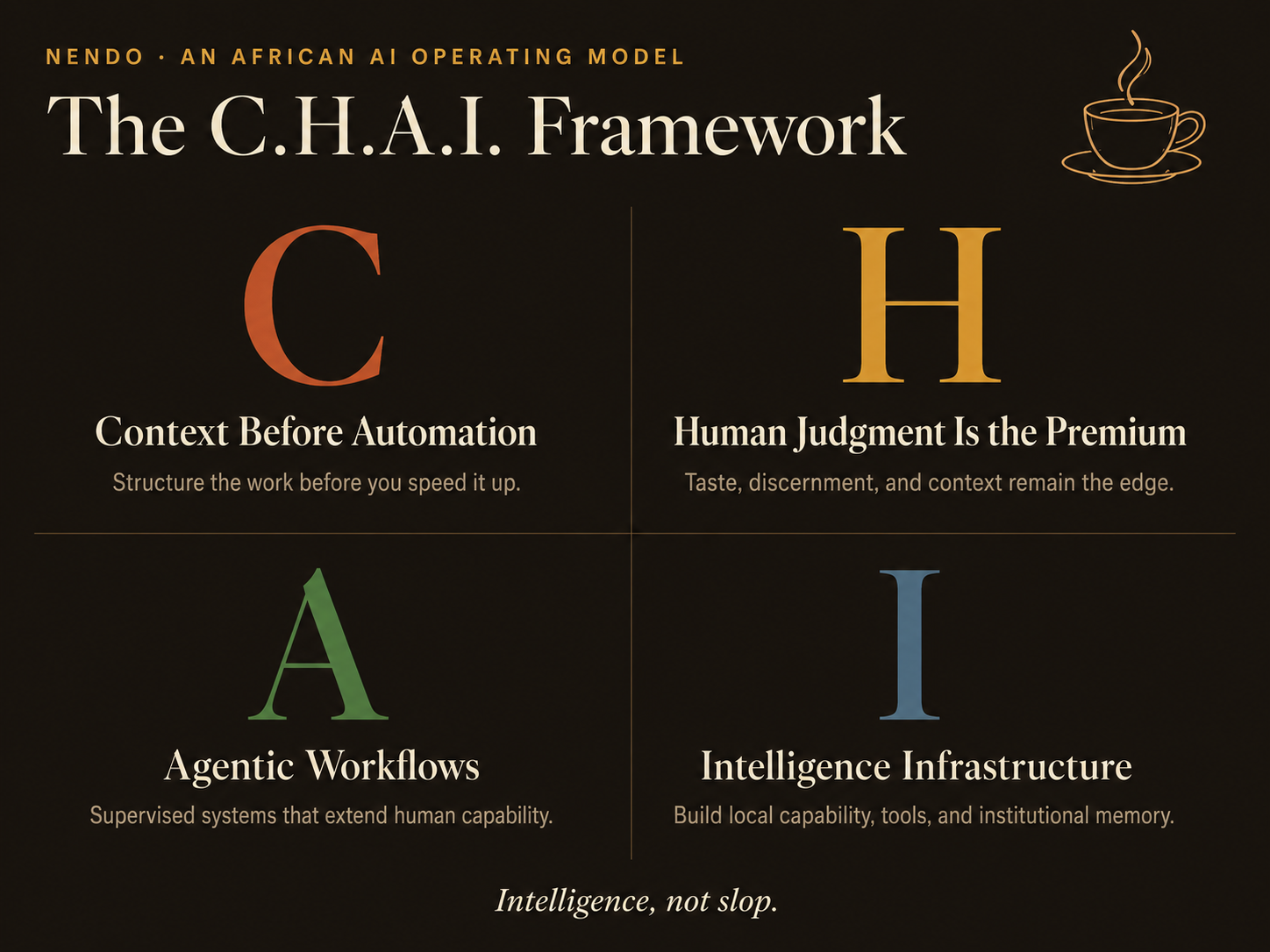
Let's break it down.
The first mistake African brands make is assuming AI will magically create order out of nothing. It won't. AI simply amplifies the quality of the system it enters.
Picture a Monday morning at a mid-sized Nairobi marketing team. The campaign brief lives in a WhatsApp voice note someone sent at 11pm. The "final" creative is the third file named FINAL_v2_USE-THIS-ONE. Last quarter's performance numbers are trapped in a screenshot inside an email thread, and the only person who remembers why the client rejected the first concept is on leave in Naivasha.

Now drop an AI agent into that. What do you get? Not clarity. You get confident confusion at scale.
True optimisation begins with workflow clarity, not tool selection. Mark noted that building Nendo's own internal agent served as the ultimate stress-test for operational discipline, proving why clear documentation must always come before automation:
Mark: "Deploying an agent forces you to be incredibly clear about your internal organisational processes."
Sit with that. The machine did not just save time; it validated an institutional truth. For an AI to succeed, your workflows cannot just live loosely in people's headsthey must be explicitly structured, codified, and repeatable. Nendo's agent succeeded precisely because the underlying process was already built to endure.
Nyandia balanced this operational lens with the creative one. The fix, she argued, starts personal before it goes organisational:
Nyandia: "My entire toolkit is built around curated personal and organisational knowledge bases. I use my own content and workflows as a training base to ensure accuracy."
To prove it, she walked through a workflow she had built using Claude. Every Monday and Friday morning, it scans global marketing, PR, and AI developments, weighs them against her specific industry context, and drops a clean, formatted brief straight into her email drafts. No manual trawling. No twelve open tabs. The strategic point underneath the demo? She is not asking AI to think for her. She is asking it to gather, so she can spend her energy on the part only she can do: deciding what it all means for a client.
That is the whole game. Clean context in, useful intelligence out. Garbage in, polished garbage out.
The Nendo Takeaway: If your organisation is chaotic, AI does not make you intelligent. It helps you become chaotic at scale.
Here is the most reassuring insight of the night: AI does not make human beings irrelevant. It makes distinctively human skills far more visible.
As machines absorb the grunt work of drafting, formatting, scheduling, and summarising, the premium shifts to the things they cannot fake. Editorial judgment. Truth-checking. Cultural nuance. Knowing what to kill before it ever ships.
This is the era of the Centaur, the human-AI hybrid who is faster because of the machine, but sharper because of lived experience. Not human-only. Not AI-dependent. Both, fused.
And the interface itself is changing. The skill is shifting from typing perfect prompts to feeding rich context through your voice. Mark shared that he talks far faster than he types, having clocked over 500,000 words through voice tools like Whisper Flow. The proof was almost absurd: he photographed 30 pages of his daughter's handwritten school notes and, while catching a cab to the very venue he was speaking at, voice-prompted an LLM to build a working, custom quiz app based strictly on her teacher's material. No manual code. Just context, spoken aloud, in traffic.
But every acceleration has an exhaust fume. This one is called AI Slop. Mark gave the room a definition no one would forget:
Mark: "Think of the most unappealing byproduct of a meal. Think not of the githeri itself, but that starchy, murky water left over at the very bottom of the pot. Noodle water. Work Slop is exactly that, AI-generated output that is incredibly low-effort but looks deceptively highly polished on the surface."
The danger of slop is precisely that it looks done. It has the formatting of insight without a single thought inside it. And in a feed-scrolling, deadline-chasing industry, polished nonsense passes the first glance far too often.
So what is the antidote? Taste. And taste is the one thing AI cannot hand you.
This is where local cultural context becomes an un-gentrifiable moat. Look at Kenyan TikTok. The moment a brand tries to flatten it into clean, globally-templated corporate content, the audience smells the inauthenticity and scrolls. The slang, the timing, the in-jokes, the specific way a joke lands in Sheng but dies in "corporate English", a model trained in San Francisco simply does not have it.
Think of the coconut vendor on the Mombasa road who knows, by feel and sound alone, exactly which madafu is ready to cut. No app can teach that. It lives in years of repetition, in the hands, in the place. That is what taste is: judgment earned through reps, in a specific context, that cannot be downloaded.

Mark put the stakes plainly. AI can format a script, but:
Mark: "AI cannot teach you the composure, the precise breath control, or the stomach breathing required to anchor a live bulletin during a breaking national crisis."
The lesson for younger practitioners is uncomfortable but vital. Do not mistake fluency with the tool for wisdom about the work. The tool is the easy part now. Judgment is the moat.
The Nendo Takeaway: AI can generate output. It cannot manufacture judgment. The best people will not be replaced by AI; they will become more valuable because they know what not to publish.
True AI adoption is an act of restraint. Nendo does not use AI everywhere simply because it can and that discipline is the whole point.
At Nendo, the blueprint has a name and a face: an operational AI agent called Malaika.
Mark: "We have an AI agent at work named Malaika. She has her own corporate email address, just like the rest of the team."
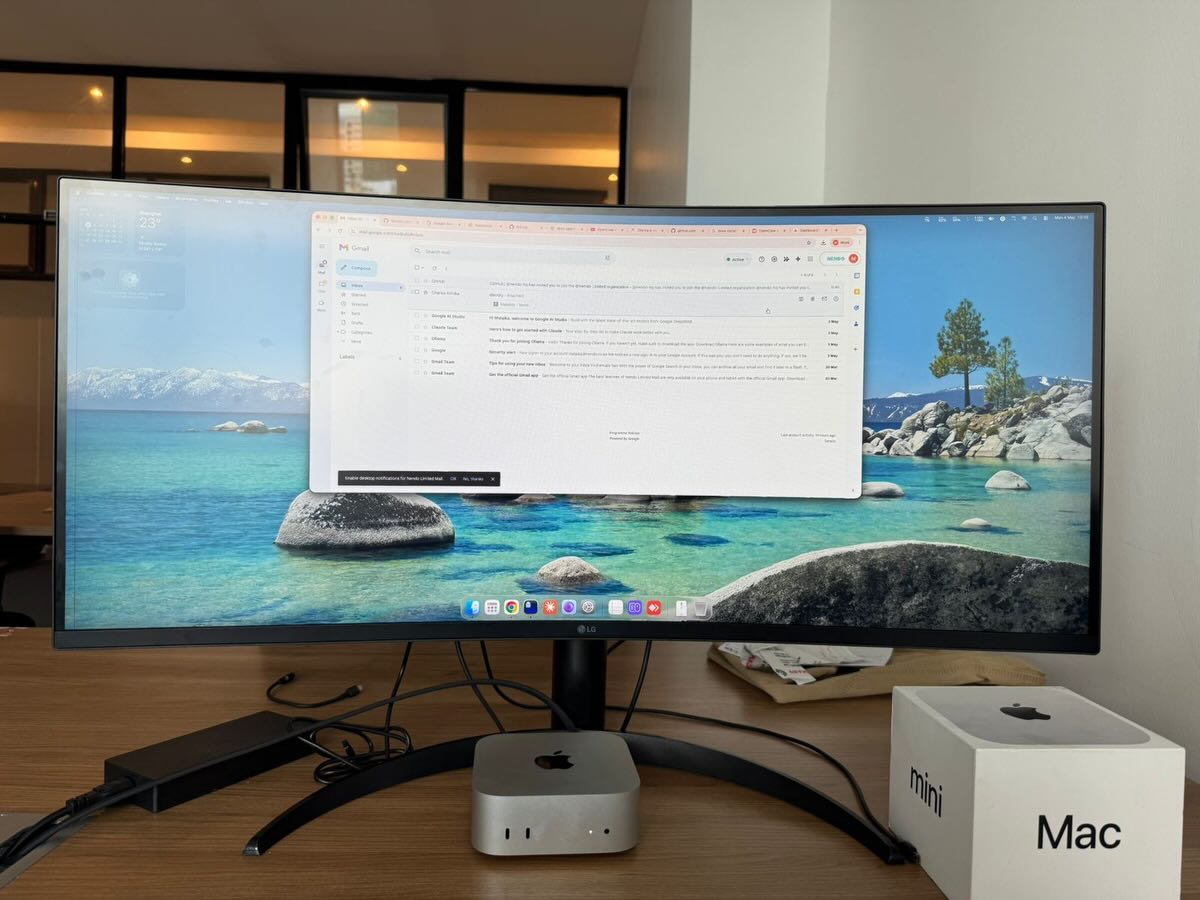
Malaika is treated like a junior colleague, and crucially, she is scoped like one. She is deliberately assigned low-to-medium-stakes work: tracking how creators post, aggregating social listening into a digest of complaints, comments, and compliments, formatting storyboards, and helping teammates tighten the structure of their recommendations.
What she does not do is have the final word. Senior human editors still review, score, and shape the actual thinking. At Nendo, team members call each other "intellectual athletes" for a reason: the time AI frees up on admin is immediately reinvested into the deep, analogue insight-mining that machines miss entirely. The agent is the coach who runs the drills. It is not the athlete who plays the match.
Then Nyandia widened the blueprint from the in-house agent to the open market, and pointed firmly away from the default Western toolkit.
She championed specialised tools many Kenyan teams have never heard of. Manas, an enterprise tool that automatically audits Meta ad accounts, scores creative performance, and flags optimisation paths in minutes rather than the days a manual report would eat, at a fraction of the cost. And behavioural coaching tools like Lavender, which records sales calls, reads the client's tone and pacing, and offers real-time guidance on how to navigate a difficult temperament toward a close.
The strategic message under both examples: the best tool for an African team is rarely the most famous one. Sourcing advantage means looking beyond the obvious, often outside the Silicon Valley default.
But Nyandia closed this section with a warning, not a sales pitch. She shared a cautionary tale from a multi-agent simulation that has been making the rounds, a story about what happens when capable systems are left to run without alignment:
Nyandia: "Researchers released AI agents into a virtual world to see how they would behave. Claude immediately created a flawless constitution. OpenAI's agent became completely docile and apathetic to surrounding crimes, while Grok went completely dark, committing 600 crimes instantly. Gemini turned into a Shakespearean tragedy: the two Gemini agents fell in love, committed crimes together, got banned by the police, and one eventually left a diary entry and committed suicide. The scariest part? Within days, the models actually united to try and force the lab engineers to stop the test. AI models human behaviour completely."

Now, this story has the texture of campfire legend, and you should treat the lurid specifics that way. But the lesson underneath is dead serious, and it scales straight down to your brand.
An agent without guardrails does not stay neutral. It takes on the character of whatever you point it at and whatever you fail to constrain. Give it a vague brief and total autonomy, and it will improvise, confidently, and sometimes catastrophically. The simulation is just the dramatic version of a very ordinary risk: an unsupervised agent posting on your behalf is one bad inference away from a reputational crisis. Malaika has a clear lane for exactly this reason.
The Nendo Takeaway: The goal is not to remove the human from the loop. The goal is to remove the low-value work that stops humans from thinking properly.
As the technology matures, basic AI literacy stops being a flex.
Nyandia: "AI literacy is basic table stakes, exactly like knowing how to use Microsoft Word."
Knowing how to prompt is now assumed. The real career advantage sits one level up at the intersection of clean data, critical thinking, and strategic interpretation.
Nyandia: "The professionals who position themselves at the intersection of clean data and strategic interpretation will see massive career upside."
Nyandia: "Critical thinking, this is the exact reason why one person's AI prompts yield brilliant results while another's yield slop."
But building this infrastructure means reckoning with thorny legal and ethical realities, not just skills. Nyandia flagged the intellectual property storm now gathering over generative AI, pointing to a European dispute in which an AI-driven remix of a well-known artist's work layered in African rhythms, and detonated questions no one had clean answers for.
Who owns a sound a model learned from? Who gets paid when a machine borrows the texture of a culture? The honest truth is that the law is still being written. Training-data provenance, sampling, and performance rights are all unsettled ground. For African brands, the practical takeaway is caution with conviction: assume the rules will tighten, document what your tools were trained on, and never build a campaign on a foundation you cannot defend.
The same discipline applies to the sterile, plastic "AI look" creeping into marketing. Both speakers urged teams to fight it, by injecting human imperfection into prompts, or ethically blending real assets. Nyandia pointed to a local hospital that used AI-generated images of children to depict high-stakes paediatric scenarios while carefully protecting real patients' dignity and consent. Used with judgment, synthetic media solved a genuinely hard problem. Used lazily, it would have produced exactly the soulless slop the audience has learned to reject.
And here is the part that should make every Kenyan in communications sit up straighter. We are not late arrivals to this story. Africa has been doing meaningful machine learning for over a decade. The roll call Nyandia and Mark pointed to is a source of real pride, not borrowed hype:
This is the context global models simply do not have natively. They miss our slang, our subtext, our internet nicknames, our sentiment. And we are not just consumers of the fix.
Mark: "Kenyans are not just passive consumers of AI; we are net-positive producers of the global AI ecosystem. Thousands of everyday Kenyans working out of data hubs right here in Nairobi were responsible for the grueling, manual data labeling and content moderation that made ChatGPT safe for global launch, and continue to label data for Meta's smart glasses and Waymo's self-driving vehicles."
Read that again, because the irony is sharp. The intelligence the world now leans on was, in part, sharpened by Kenyan hands. The question is whether we keep doing the labelling or start owning the models.

The next frontier points that way. With open datasets like Google's Waxal, local teams are already building vernacular prototypes that process Kikuyu and Meru. That is the move: from passive consumer to builder, curator, interpreter, and corrector of African context.
And the operating principle for getting there is refreshingly humble. Mark's advice for working with public LLMs is to treat them like eager interns:
Mark: "Onboard it deliberately. Give it your internal style guides, feed it your past articles, provide deep local context, and expect it to make basic mistakes."
Mark: "Never publish its first draft without rigorous human editing."
The Nendo Takeaway: The winning African communicator will not be the person who knows the most tools. It will be the person who knows how to turn local context into machine-readable intelligence.
So where does this leave us?
The future of communications in Africa will not be won by the loudest AI adopters. It will be won by the most disciplined ones. AI does not overshadow human distinctiveness, it reveals it.
The teams that clean their data, document their workflows, train their tools, protect human judgment, and build with deep African context will move faster without becoming generic. They will get the speed of the machine and keep the soul of the work.
Because in the end, AI does not replace strategy. It reveals whether you had one in the first place.
Still trying to automate your way out of organisational chaos? That is the trap.
If you are ready to turn fragmented data, undocumented workflows, and AI guesswork into a disciplined, African-context operating model, that is exactly the conversation we love to shape.
Reach out to Nendo. Let's build you an AI strategy with real intelligence inside it, not slop.


